‘Opera can be fun’.‘The Magic Flute’ has been renovated for Opera Otago to bring it into the world of today. Even though the music remained untouched, this version is sung in English and includes high-tech stage effects. Thank you John Drummond – it’s a marketer’s dream!
We need innovative approaches such as these to broaden, deepen and diversify our audiences in today’s world. Some will be seeing this innovation as ‘a potential risk’. The bigger risk though, is not to reach out to new audiences and by doing so, not cultivating new opera fans for life.
Our audiences have more artistic choices than ever before, giving the arts practitioner and marketer more opportunities to be creative. It encompasses the entire creative process from programming via artistic creation, performance, outreach and marketing of the production. As in the case of the renovated ‘Magic Flute’, we should be creative and innovative to open arts such as opera to all and not to a selective few ‘opera connoisseurs’ – the opera belongs to everyone!
The question arises, how should we achieve this? Some pointers: innovative marketing methods using technology and the internet to reach out to younger audiences; innovative productions with young fresh faces and voices, such as in ‘The Magic Flute’; using new language (and a little bit of swearing in the script!) to reach and engage a younger audience. In my experience as a marketer, appealing to traditional audiences and relying on familiar methods of audience connections are no longer enough – we must become more creative on how to connect with the public.
We should understand the emotional landscape of and develop our audience as ‘custodians of the arts’ to ensure buy-in and survival of our art form. Opera Otago’s ‘The Magic Flute’ has all the ingredients to achieve these goals. Long live the Opera, long live our renovated ‘Magic Flute’! See you at the show!
Post by Pieter du Plessis, Marketing Manager – Opera Otago
My daughter perks up when she hears me rehearsing my music for The Magic Flute. I’m not surprised, really. The last time I sang the role of the Third Lady, I was living in South East London, travelling a two hour round trip to Camden for rehearsals and in the early stages of pregnancy. Luckily, I wasn’t yet suffering from the all-day morning sickness which made travelling to rehearsals for my next operas so…challenging.
Claire with her daughter Margaret
It’s a bit ironic to come home to Dunedin after so long, only to find that, lo and behold, the first opera role I take on is one that seems to have followed me in my three years living in the United Kingdom. I studied the role of Third Lady at Trinity, work-shopped it with director Simon McBurney, and sang it English with Brent Opera.
The Three Ladies are fascinating characters to play. These women are seething with lust towards Tamino, but they are constrained by their work from doing anything about it. Mozart does not give them names; they have no place in the opera beyond their servitude to the Queen of the Night. This means that directorial interpretations of these characters can vary wildly.
In Opera Otago’s production, the Three Ladies are traders on the international commodities market. I’ve been part of a trio of ladies who have been glamourous 1940s figures. I’ve sung a Third Lady dressed in harem pants and dancing Bollywood-style. In one scene while work-shopping, our director suggested the Three Ladies were almost Maenad-like, and had the three of us attempt to tear an unconscious Tamino limb from limb. The theme running through all of these different interpretations is that normally, the three ladies are doing something fairly energetic on stage…
Handy then that I can keep fit by running after an energetic 14 month-old.
Evil is present in all societies, but nowhere is evil expressed quite so wrathfully as in the character of the Queen of the Night. She is consumed with the desire to control all in her world, letting nothing stand in her way.
This production sees the Queen running a company and making millions, with any legal or moral qualms left in her dust. Her desire for money is only matched by her need to always win, lending itself to a rather twisted story. She can cleverly manipulate people to do whatever it is she wants, resulting in a personality perfectly reflected in the music, with passages of beautiful longing contrasting rapidly with wrathful vengeance.
It is in these arias of the Queen that we clearly hear what she is like, with stratospheric spells as she reaches high F6. Composed for Mozart’s sister in law who had an extraordinary upper register, both arias were written specifically to showcase those high notes. The effect is incredibly difficult to master, but what music eventuates!
John Drummond’s depiction of today’s Queen of the Night is a fresh look at the character in modern time, whilst being able assisted by Mozart’s athletic and beautiful music…With her entourage of shady traders, John Drummond’s Queen showcases the ruthlessness of modern commerce.
Performing music has a lot in common with high level performance sports. Picture the line up of All Blacks as they pass off the ball one to another to score a try; the tennis player acing a serve; the basketball effortlessly dropping through the hoop without touching the rim; Lydia Ko guiding a golf ball across the green and straight into the hole. Of course, we all know the hours of preparation that go in for great sports people to make their sport look effortless.
There is nothing I hate about playing Mozart, but to make his music sound as it should does demand of the musicians great refinement of detail and the highest level of physical and musical synchronisation. Only then can we create the purity of sound and the seemingly effortless simplicity and clarity of classical musical expression at it highest that Mozart’s scores demand. Playing Mozart is utterly revealing as not one note can be out of place without one noticing- no pressure!
As I write this blog, I am contemplating the hours I am about to spend bowing the string parts in preparation for the first rehearsals of the orchestra. Articulations and bowings in classical music were, and are still, very particular because certain bowings create and reflect particular sounds and phrasings. In this way I have to be sure that the strings synchronise their bowings and speak as one musical voice.
However, this is only the very first step in crafting a Mozart orchestra to accompany the opera. In the pursuit of pure chamber music, my colleagues and I will strive for the perfect balance of melody, countermelody and accompaniment in a way that supports and enhances what you see and hear on the stage. I look forward to revisiting and continuing my relationship with Mozart’s “Magic Flute” in this latest version created by John Drummond.
Twenty-four years ago I toured the original work around the UK with the company Opera North, performing in delightful old opera houses of a similar size to the Mayfair theatre and loving every moment of the experience. I just have to remember to keep my eyes on the music and the conductor, rather than the glow of the stage!
Of the great composers, the two great voice teachers are Handel and Mozart. Mozart had a prodigious memory and was so absorbed in music he could remember easily what sounds resonated well in different parts of a singer’s voice.
Mozart’s music is sheer elegance to sing. To learn to sing with suitably arched phrases, beautiful vowels, concise and carrying consonants, and convey many facets of emotion is a skill that all singers need.
Singers also need to be so assured technically that they are free to move on stage, to act in response to the drama and convey the feelings of the character they are playing. This is all part of the preparation for the role. Singers need to know exactly who they are, why they are on the stage and who they are interacting with.
They need to be familiar with the historical background of the plot. In this renovated ‘libretto’, the necessity of having similar vowels to the German ones on the higher pitches, is not a luxury the renovator has at his disposal. So, the singer’s job of communicating the text easily to the audience is made quite difficult. However, the experiential learning from this process is profound, and can inform the singers’ subsequent performance of different music.
We all know the saying ‘It’s not over until the fat lady sings’. A section of the public associate the singing of opera with over-blown, over-developed and wobbly voices. There are no voices of that type in this opera. Each singer has been cast in a role that the Artistic Team feels will suit them, and in which they can grow both musically and dramatically.
Post by Judy Bellingham, Voice Coach for The Magic Flute
Your editor had a 20 minute interview with Robert to discuss how rehearsals are going, what he’s working on, and his insights on the production so far…
Editor: When did you start rehearsing?
Robert: Probably about a month ago, maybe more. We started from the start and walked through everything, with everyone there.
E: How often are rehearsals?
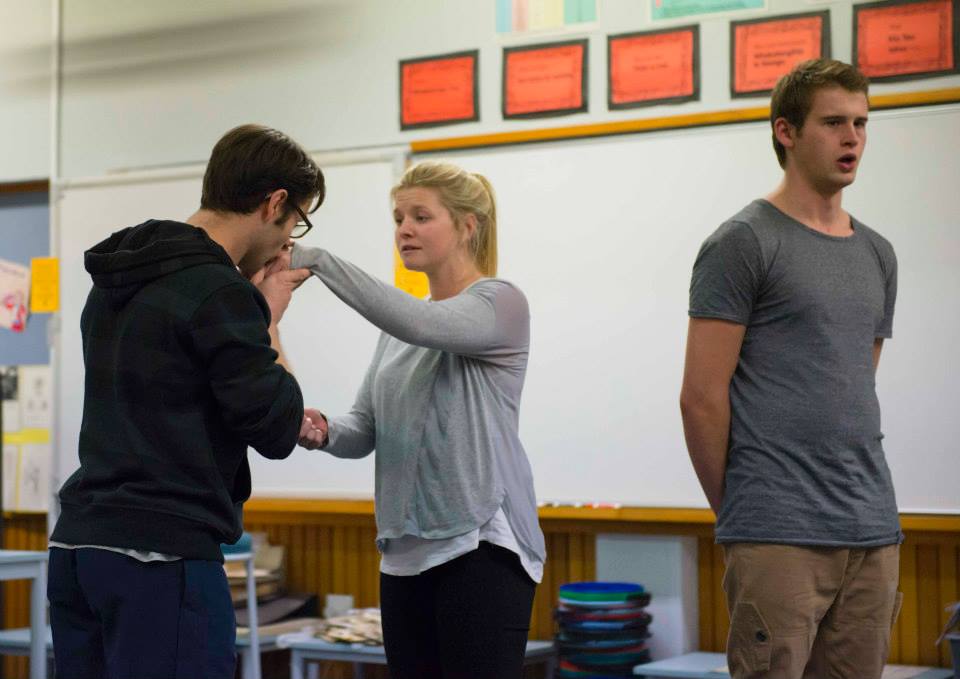
From left: James Adams, Sophie Sparrow and Robert Lindsay in rehearsal
R: We have calls on Wednesday and Friday nights, Saturday, and Sunday afternoon. You’re never needed for everything though, depending on what scene we’re up to. I don’t have anything today, for example.
E: Where are you up to now? What have you been working on?
R: We are up to the second run through now, tonight we’re about halfway through the second Act. We are critiquing and improving on each scene as we go through them, with John guiding us.
E: What about yourself? What are you working on?
R: At the moment, I’m focussed on developing my character, particularly portraying Sarastro as an old man, which is a challenge at 19! I’m getting there though, and it’s getting easier.
E: What have you enjoyed most about rehearsals so far?
R: I’ve loved the acting side, particularly with John’s [English] dialogue. It’s quite a funny dialogue, although there are some quite dramatic parts too. Most of the stuff I’m in is pretty dramatic actually. Papageno is the comedian of the group, Tyler [Neumann] is a perfect fit, he’s very funny. I’m also enjoying the camaraderie of the cast, and making some new friends. It’s a great group of people.
E: That’s wonderful. We’ll look forward to Tyler’s contribution to the blog then! What has been the most challenging thing for you?
R: Learning all the music and dialogue has been quite hard. However, the fact that it’s in English really helps! It makes it easier for me to connect with the arias and songs when it comes to performing them. [Robert Lindsay played Sarastro in the University of Otago Music Department’s Magic Flute Moments (Aug 2014) where he sang an abridged version of the role in German]E: So where have you been rehearsing?R: We’ve been in the Music room at the Teacher’s college. It’s great for us that it’s on campus.
E: And when do you move to the theatre?
R: I think it’s at Queen’s Birthday Weekend? About two weeks before opening night.
E: Fantastic. Are you looking forward to being in the theatre?
R: Yes, I can’t wait! It’s going to be quite stressful too though, because our exams start around then.
E: Yes I bet. How have you been finding juggling rehearsals with study?
R: It’s been ok, fairly stressful, but you just have to be really organised. I’m a bit behind in my singing repertoire, but it will be ok because Magic Flute actually counts towards my assessment for the year. It’s definitely worth it for the experience anyway!
E: Of course! So have you got lots of fans booked to come?
R: Yes actually, and lots of friends who have never been to an opera before, including my flatmates. Unfortunately my mum is going to be overseas, but she’ll hopefully be able to come to a dress rehearsal. My dad and my brother will be coming up from Invercargill for it though.
E: What do you think the audience is going to love?
R: I think the audience will love how well the story has been transformed into a modern context. It comes together extremely well, and makes the story easy to relate to.
E: That’ll be great for your opera first-timers. So how does your character fit in to this modern context?
R: Sarastro is a greenie, excluded from modern society. He believes that people should find their own pathway themselves. I guess he’s a hippy really!
E: What about your Priests? Where do they come in?
R: The traditional ‘Priests’ are now ‘Followers’ and are part of the greenie group. They spend their time studying the writings of their leader – me! [laughs]
E: Are there any surprises in store?
R: Monostatos is played by Ben Madden, and his aria is pretty interesting…the words are…well you’ll have to come see! People will love his aria, I thoroughly enjoy it every time I hear it.
E: Wow, sounds intriguing! Is there anything else you’re looking forward to?
R: I’ve heard a lot about the lighting and projections that will be used. I’m pretty excited to see how they turn out in the theatre – they sound awesome!
E: Yes, we’ve been hearing lots of rumours! We’re just about out of time Robert, do you have any last thoughts?
R: Tell everyone you know to book their tickets!! We can’t wait to be performing at The Mayfair, June 13, 15, 17 and 19.
Enter Tamino, pursued by a serpent. In the original version, this is the opening action of Mozart’s Magic Flute. It’s the usual sort of thing handsome princes have to put up with, along with falling in love at the drop of a hat, and going on a quest to rescue a maiden in distress, both of which Tamino goes on to do in remarkably short order.
Tamino is attacked by the serpent in Sarasota Opera’s 2004 production of The Magic Flute (Stage Director: William Gustason Set Designer: Troy Hourie)
But what if you’re not a handsome prince?
What if you’re a bookish, naive young lad on a walking holiday, and you just happen to find yourself in the middle of a fairytale?
John [Drummond]’s renovation of the Magic Flute puts Tamino in an entirely new set of shoes. A quest might be de rigueur for Prince Tamino, but it’s scarily unfamiliar to Tamino Prince.
It’s a fresh angle on a well worn character, and it’s a welcome challenge for me. The “handsome prince” is a well known trope, and it’s easy to fall into a stereotypical pattern; the new Tamino demands a new look at the character, reassessing his place in the drama, the way he responds to the challenges in front of him, and how he changes as a result.
A remarkable thing, though, is going back to the music with fresh eyes…to find that Mozart, from 200 odd years ago, is way ahead of me. The excitement, doubt, resolution of the character is all there – I’m sure the “handsome prince” was already a familiar idea in 1791, but Mozart’s handling of his music shows an attention to character detail that indicates he, at least, had no truck with stereotypes.
As always, Mozart’s elegant music is deceptively demanding. Each rehearsal, we find another nuance, another layer of character, another technical demand to come to grips with – everything opera should be. Just without a handsome prince…
…Well, at least he’s still handsome. If I say so myself.
We are excited to announce that The Magic Flute Blog will be having it’s first entry tomorrow evening (Sunday 17 May 2015). This blog will be a chance for you to get to know the cast, the characters, and all the behind the scenes preparation that happens to put an opera on a stage. Contributors will include:
James Adams – Prince Tamino (or is it Tamino Prince?)
Brenda Rendall – Costume designer and creator (Measuring up: Top tips from my years of experience in the wardrobe)
Pieter du Plessis – Marketing Manager (Creatively bringing audiences to the theatre)
Kurt Murphy – Flautist (On playing ‘The Magic Flute’ – the flautist’s perspective)
Sophie Sparrow – Pamina (Ready for my debut! A Diva’s Diary from the dressing room)
Stay tuned on Sundays, Wednesdays and Fridays for the latest entries. Feel free to comment with questions, insights and feedback – we love to hear what you think!
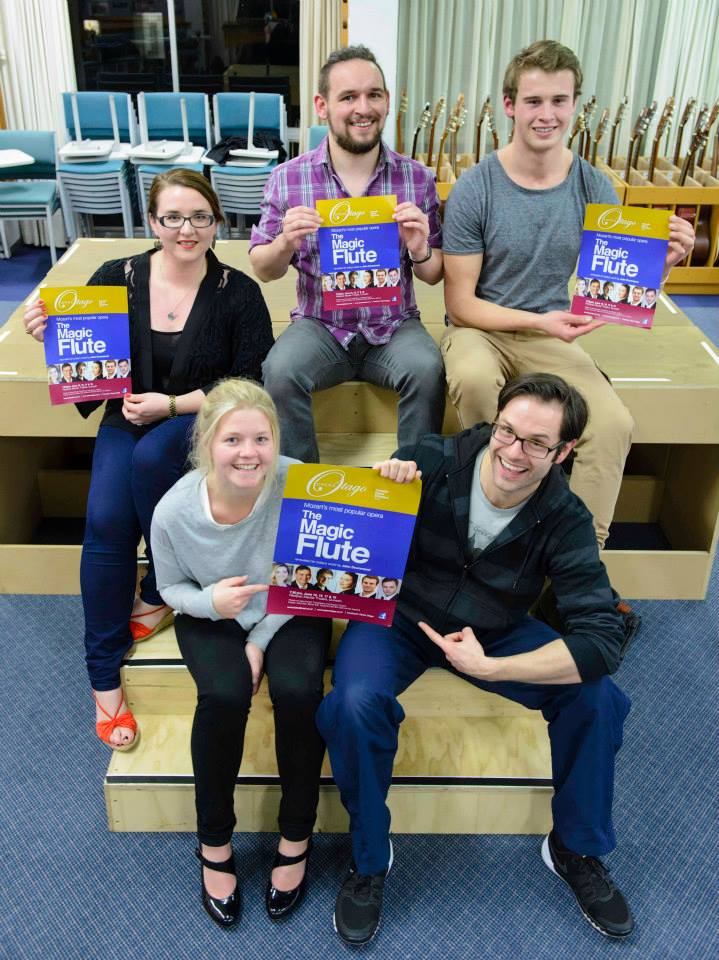
Clockwise from top left: Ingrid Fomison-Nurse (Queen of the Night), Ben Madden (Monostatos), Robert Lindsay (Sarastro), James Adams (Tamino) and Sophie Sparrow (Pamina)
As the nights get longer and the temperatures crisper I always think that these conditions lend themselves to our art form. What better way to relax than to sit in a warm theatre and be transported to another place and time by the music and story of a favourite opera. So I hope you have entered a date in your diaries to purchase tickets and get to a performance of The Magic Flute. And encourage your families and friends to do the same! While this is our main focus at the moment, you will see by the contents of the newsletter that a lot has been happening. I will let the rest of the contributions speak for themselves but will just add a couple of things.
Firstly I must pay tribute to the three members of the 2014 -2015 executive who did not stand again this year. Michael Andrewes, Linda Brewster and Vickie Cross worked tirelessly for the Company over the period they were members and I extend my grateful thanks to them for their contribution.
Secondly I welcome their replacements for the new term. It is with pleasure that we report that our long serving and award winning costume designer Brenda Rendall has joined us, along with Claire Barton and husband Simon Wilson. We know that they will all bring new skills and enthusiasm with them. The added benefit of having Claire and Simon is that their little daughter, Margaret, has been attending meetings and is learning the ropes at a very early age!
Thirdly thanks to all who supported our raffle which generated much needed revenue for our coffers. The winning numbers are presented later on in the newsletter.
Finally it is with mixed feelings that I report that we are soon to lose the highly valued services of Georgia Gray who is editing this newsletter and has been editing much of our other written material and working on our website. Georgia was keen to stay involved with executive even though she has been living in Wellington since the end of 2014. It has been a most successful “long distance” role and one which we have appreciated greatly. However, she is shifting to Paris with her partner Clément in July. I extend my best wishes to them for this career move. We will miss her wise and thoughtful contribution as well as her practical skills.
We’re three weeks into rehearsals and having a great time! By the end of this weekend we’ll have the basic moves sorted out for the opera. That’s like having the blueprints of the production mapped out, so that we can then construct the reality that audiences will enjoy. Mozart’s music is, of course, a delight and an inspiration to all of us. Our young singers bring fresh voices and eager commitment. The ensembles sound glorious, and the solo arias are starting to live and breathe in a Mozartian style. The challenges of delivering spoken dialogue are being met. Characters are starting to form. Those who haven’t been in an opera before are finding out how difficult it is (so much to think about!), but we’re all helping each other. The cast – and our great production personnel – is working as a team. As I pointed out when we first gathered together, every person’s goal is to make the other people in the cast look and sound good. Cues aren’t what other people give you; they are what you give other people. It’s exciting, and it’s fun!













 Opera Otago