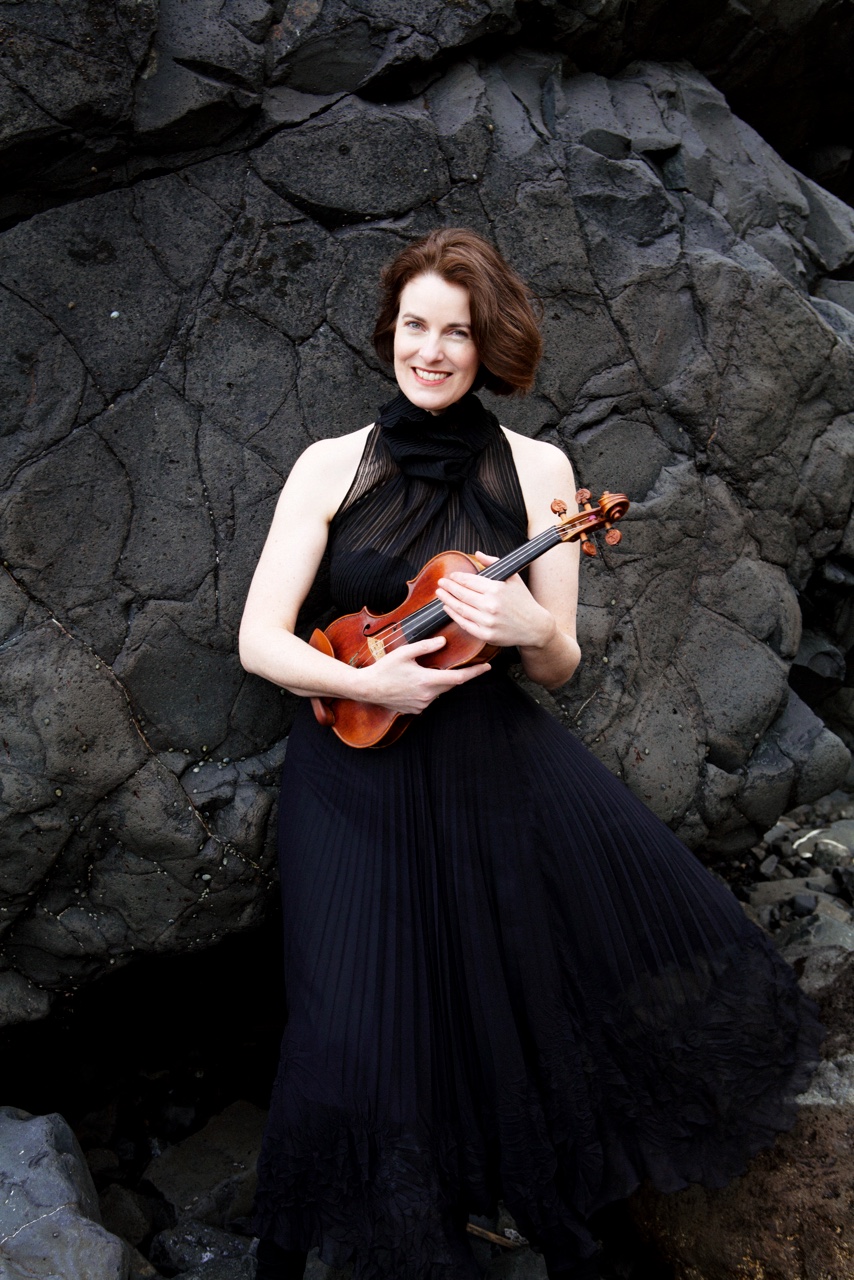
Performing music has a lot in common with high level performance sports. Picture the line up of All Blacks as they pass off the ball one to another to score a try; the tennis player acing a serve; the basketball effortlessly dropping through the hoop without touching the rim; Lydia Ko guiding a golf ball across the green and straight into the hole. Of course, we all know the hours of preparation that go in for great sports people to make their sport look effortless.
There is nothing I hate about playing Mozart, but to make his music sound as it should does demand of the musicians great refinement of detail and the highest level of physical and musical synchronisation. Only then can we create the purity of sound and the seemingly effortless simplicity and clarity of classical musical expression at it highest that Mozart’s scores demand. Playing Mozart is utterly revealing as not one note can be out of place without one noticing- no pressure!
As I write this blog, I am contemplating the hours I am about to spend bowing the string parts in preparation for the first rehearsals of the orchestra. Articulations and bowings in classical music were, and are still, very particular because certain bowings create and reflect particular sounds and phrasings. In this way I have to be sure that the strings synchronise their bowings and speak as one musical voice.
However, this is only the very first step in crafting a Mozart orchestra to accompany the opera. In the pursuit of pure chamber music, my colleagues and I will strive for the perfect balance of melody, countermelody and accompaniment in a way that supports and enhances what you see and hear on the stage. I look forward to revisiting and continuing my relationship with Mozart’s “Magic Flute” in this latest version created by John Drummond.
Twenty-four years ago I toured the original work around the UK with the company Opera North, performing in delightful old opera houses of a similar size to the Mayfair theatre and loving every moment of the experience. I just have to remember to keep my eyes on the music and the conductor, rather than the glow of the stage!
Of the great composers, the two great voice teachers are Handel and Mozart. Mozart had a prodigious memory and was so absorbed in music he could remember easily what sounds resonated well in different parts of a singer’s voice.
Mozart’s music is sheer elegance to sing. To learn to sing with suitably arched phrases, beautiful vowels, concise and carrying consonants, and convey many facets of emotion is a skill that all singers need.
Singers also need to be so assured technically that they are free to move on stage, to act in response to the drama and convey the feelings of the character they are playing. This is all part of the preparation for the role. Singers need to know exactly who they are, why they are on the stage and who they are interacting with.
They need to be familiar with the historical background of the plot. In this renovated ‘libretto’, the necessity of having similar vowels to the German ones on the higher pitches, is not a luxury the renovator has at his disposal. So, the singer’s job of communicating the text easily to the audience is made quite difficult. However, the experiential learning from this process is profound, and can inform the singers’ subsequent performance of different music.
We all know the saying ‘It’s not over until the fat lady sings’. A section of the public associate the singing of opera with over-blown, over-developed and wobbly voices. There are no voices of that type in this opera. Each singer has been cast in a role that the Artistic Team feels will suit them, and in which they can grow both musically and dramatically.
Post by Judy Bellingham, Voice Coach for The Magic Flute
Your editor had a 20 minute interview with Robert to discuss how rehearsals are going, what he’s working on, and his insights on the production so far…
Editor: When did you start rehearsing?
Robert: Probably about a month ago, maybe more. We started from the start and walked through everything, with everyone there.
E: How often are rehearsals?
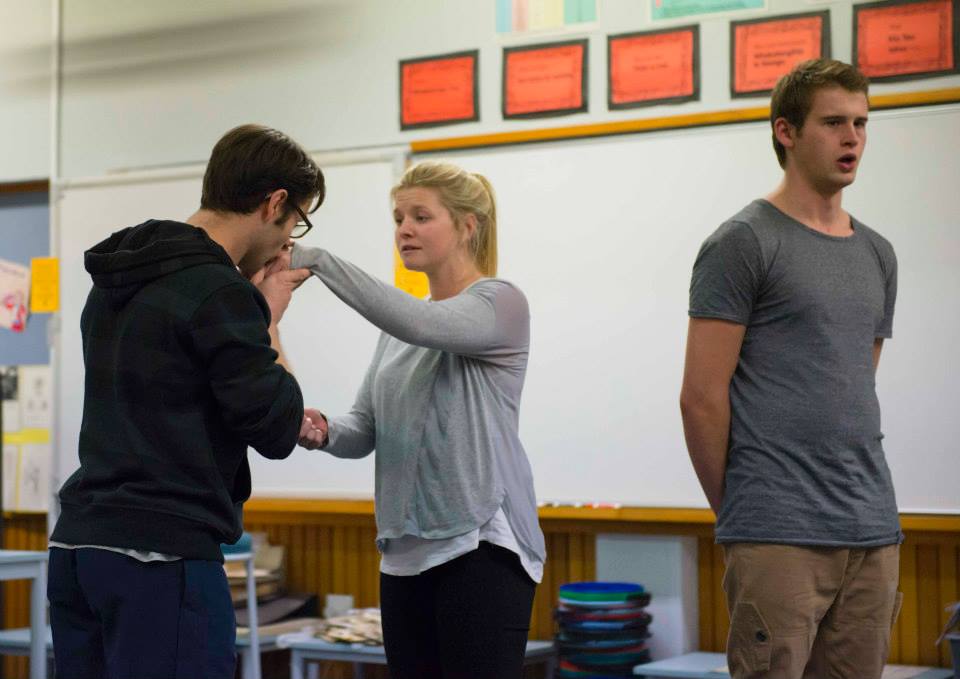
From left: James Adams, Sophie Sparrow and Robert Lindsay in rehearsal
R: We have calls on Wednesday and Friday nights, Saturday, and Sunday afternoon. You’re never needed for everything though, depending on what scene we’re up to. I don’t have anything today, for example.
E: Where are you up to now? What have you been working on?
R: We are up to the second run through now, tonight we’re about halfway through the second Act. We are critiquing and improving on each scene as we go through them, with John guiding us.
E: What about yourself? What are you working on?
R: At the moment, I’m focussed on developing my character, particularly portraying Sarastro as an old man, which is a challenge at 19! I’m getting there though, and it’s getting easier.
E: What have you enjoyed most about rehearsals so far?
R: I’ve loved the acting side, particularly with John’s [English] dialogue. It’s quite a funny dialogue, although there are some quite dramatic parts too. Most of the stuff I’m in is pretty dramatic actually. Papageno is the comedian of the group, Tyler [Neumann] is a perfect fit, he’s very funny. I’m also enjoying the camaraderie of the cast, and making some new friends. It’s a great group of people.
E: That’s wonderful. We’ll look forward to Tyler’s contribution to the blog then! What has been the most challenging thing for you?
R: Learning all the music and dialogue has been quite hard. However, the fact that it’s in English really helps! It makes it easier for me to connect with the arias and songs when it comes to performing them. [Robert Lindsay played Sarastro in the University of Otago Music Department’s Magic Flute Moments (Aug 2014) where he sang an abridged version of the role in German]E: So where have you been rehearsing?R: We’ve been in the Music room at the Teacher’s college. It’s great for us that it’s on campus.
E: And when do you move to the theatre?
R: I think it’s at Queen’s Birthday Weekend? About two weeks before opening night.
E: Fantastic. Are you looking forward to being in the theatre?
R: Yes, I can’t wait! It’s going to be quite stressful too though, because our exams start around then.
E: Yes I bet. How have you been finding juggling rehearsals with study?
R: It’s been ok, fairly stressful, but you just have to be really organised. I’m a bit behind in my singing repertoire, but it will be ok because Magic Flute actually counts towards my assessment for the year. It’s definitely worth it for the experience anyway!
E: Of course! So have you got lots of fans booked to come?
R: Yes actually, and lots of friends who have never been to an opera before, including my flatmates. Unfortunately my mum is going to be overseas, but she’ll hopefully be able to come to a dress rehearsal. My dad and my brother will be coming up from Invercargill for it though.
E: What do you think the audience is going to love?
R: I think the audience will love how well the story has been transformed into a modern context. It comes together extremely well, and makes the story easy to relate to.
E: That’ll be great for your opera first-timers. So how does your character fit in to this modern context?
R: Sarastro is a greenie, excluded from modern society. He believes that people should find their own pathway themselves. I guess he’s a hippy really!
E: What about your Priests? Where do they come in?
R: The traditional ‘Priests’ are now ‘Followers’ and are part of the greenie group. They spend their time studying the writings of their leader – me! [laughs]
E: Are there any surprises in store?
R: Monostatos is played by Ben Madden, and his aria is pretty interesting…the words are…well you’ll have to come see! People will love his aria, I thoroughly enjoy it every time I hear it.
E: Wow, sounds intriguing! Is there anything else you’re looking forward to?
R: I’ve heard a lot about the lighting and projections that will be used. I’m pretty excited to see how they turn out in the theatre – they sound awesome!
E: Yes, we’ve been hearing lots of rumours! We’re just about out of time Robert, do you have any last thoughts?
R: Tell everyone you know to book their tickets!! We can’t wait to be performing at The Mayfair, June 13, 15, 17 and 19.
Enter Tamino, pursued by a serpent. In the original version, this is the opening action of Mozart’s Magic Flute. It’s the usual sort of thing handsome princes have to put up with, along with falling in love at the drop of a hat, and going on a quest to rescue a maiden in distress, both of which Tamino goes on to do in remarkably short order.
Tamino is attacked by the serpent in Sarasota Opera’s 2004 production of The Magic Flute (Stage Director: William Gustason Set Designer: Troy Hourie)
But what if you’re not a handsome prince?
What if you’re a bookish, naive young lad on a walking holiday, and you just happen to find yourself in the middle of a fairytale?
John [Drummond]’s renovation of the Magic Flute puts Tamino in an entirely new set of shoes. A quest might be de rigueur for Prince Tamino, but it’s scarily unfamiliar to Tamino Prince.
It’s a fresh angle on a well worn character, and it’s a welcome challenge for me. The “handsome prince” is a well known trope, and it’s easy to fall into a stereotypical pattern; the new Tamino demands a new look at the character, reassessing his place in the drama, the way he responds to the challenges in front of him, and how he changes as a result.
A remarkable thing, though, is going back to the music with fresh eyes…to find that Mozart, from 200 odd years ago, is way ahead of me. The excitement, doubt, resolution of the character is all there – I’m sure the “handsome prince” was already a familiar idea in 1791, but Mozart’s handling of his music shows an attention to character detail that indicates he, at least, had no truck with stereotypes.
As always, Mozart’s elegant music is deceptively demanding. Each rehearsal, we find another nuance, another layer of character, another technical demand to come to grips with – everything opera should be. Just without a handsome prince…
…Well, at least he’s still handsome. If I say so myself.
We are excited to announce that The Magic Flute Blog will be having it’s first entry tomorrow evening (Sunday 17 May 2015). This blog will be a chance for you to get to know the cast, the characters, and all the behind the scenes preparation that happens to put an opera on a stage. Contributors will include:
James Adams – Prince Tamino (or is it Tamino Prince?)
Brenda Rendall – Costume designer and creator (Measuring up: Top tips from my years of experience in the wardrobe)
Pieter du Plessis – Marketing Manager (Creatively bringing audiences to the theatre)
Kurt Murphy – Flautist (On playing ‘The Magic Flute’ – the flautist’s perspective)
Sophie Sparrow – Pamina (Ready for my debut! A Diva’s Diary from the dressing room)
Stay tuned on Sundays, Wednesdays and Fridays for the latest entries. Feel free to comment with questions, insights and feedback – we love to hear what you think!
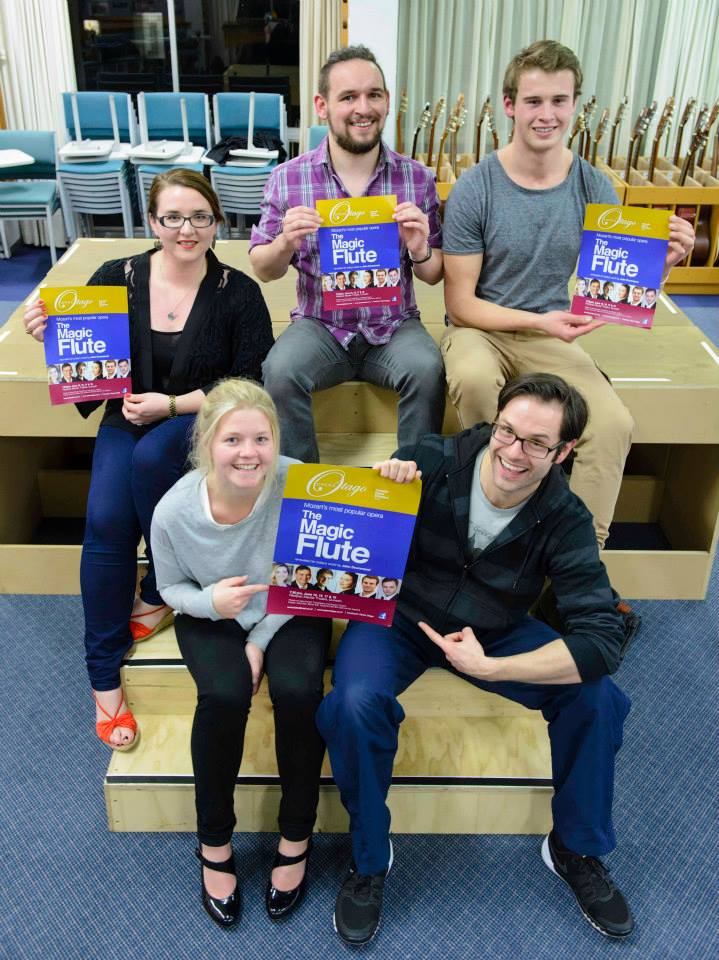
Clockwise from top left: Ingrid Fomison-Nurse (Queen of the Night), Ben Madden (Monostatos), Robert Lindsay (Sarastro), James Adams (Tamino) and Sophie Sparrow (Pamina)
We’re three weeks into rehearsals and having a great time! By the end of this weekend we’ll have the basic moves sorted out for the opera. That’s like having the blueprints of the production mapped out, so that we can then construct the reality that audiences will enjoy. Mozart’s music is, of course, a delight and an inspiration to all of us. Our young singers bring fresh voices and eager commitment. The ensembles sound glorious, and the solo arias are starting to live and breathe in a Mozartian style. The challenges of delivering spoken dialogue are being met. Characters are starting to form. Those who haven’t been in an opera before are finding out how difficult it is (so much to think about!), but we’re all helping each other. The cast – and our great production personnel – is working as a team. As I pointed out when we first gathered together, every person’s goal is to make the other people in the cast look and sound good. Cues aren’t what other people give you; they are what you give other people. It’s exciting, and it’s fun!
2014 Graduate: BMus Honours in Classical Voice at Otago University
Lexus Song Quest Masterclass 2014 with judge Kathryn Harries; finalist Dunedin Aria
Enjoys the outdoors and travelling; plays Hockey for the University of Otago
“This has always been a dream role of mine. I enjoy singing Mozart’s music – at times, it can be technically challenging, but it is an amazing opportunity! Rehearsals have been great and well-structured, we have got through the blocking. I look forward to developing my character more through understanding the inner-workings of Pamina.”
James Adams: Tamino
James Adams: Tamino
Dunedin-born, but has been in Wellington for the last 10 years. Recently returned with his wife to be closer to family – in time for the arrival of their now ten-month-old baby!
Has a degree in performance from NZSM – he completed it as a baritone
Played ‘Samuel Marsden’ in Opera Otago’s production of Anthony Ritchie’s This Other Eden in 2014
“John’s ‘renovation’ brings a new angle to Tamino – he’s not a prince anymore, but more an everyman who falls into a strange and unexpected situation. It’s a new way of shaping the character that I’m really enjoying.”
Ingrid Fomison-Nurse: Queen of the Night
Ingrid Fomison-Nurse: Queen of the Night
Originally from Canterbury
Age 25
Studies privately with Judy Bellingham“I am incredibly excited to be singing the role of the Queen of the Night. The music is of course magical, and the Queen’s arias are fantastic to sing: challenging but incredibly energising and rewarding. Rehearsals have been lots of fun with a great group of people. It’s really exciting to watch characters forming and the story becoming real.”
Benjamin Madden: Monostatos
Benjamin Madden: Monostatos
Born and bred Dunedinite, Otago Boys educated
Recent Graduate: BMus (Classical Singing) and BA (Philosophy)
Currently enjoying the challenges of teaching and directing choirs, whilst balancing a busy performance schedule around the country
“I’m enjoying the challenges of inhabiting a nasty character, Monostatos. I’m also looking forward to seeing the many aspects of this production come together – particularly some of the rumoured hi-tech wizardry!”
Robert Lindsay: Sarastro
Robert Lindsay: Sarastro
From Invercargill
Age 19, this is his first operatic role
In his 2nd year of voice studies at Otago University, studying under Judith Henley
“Playing an old man at 19 is definitely a challenge, but I’m really looking forward to the performances. It’s going to be a great experience!”
Tyler Neumann: Papageno
Tyler Neumann: Papageno
3rd year physics and classical singing student at University of Otago
Musical background of musical theatre and choral singing
Singing ‘Papageno’ is his first operatic role
“As a cast composed of nearly all Otago musicstudents, there is a huge sense of comradeship that has been a tremendous pleasure to be part of. Papageno is such a fun character to play. His simple wants and quirky nature, putting him so firmly at odds with his morally-driven counterparts, places him at the heart of this opera’s comedic nature.”









 Opera Otago